

Hello fellow human,
Only a few months before making $100k+ every 30 days with TikTok Shop, Jackie was a nurse.
For context: she married her high school sweetheart, worked a steady job for years, and built a life around her career. (i.e. she’s not unlike you.)
One day, she stumbled onto TikTok Shop (the way a lot of people stumble onto things online.) She wasn’t LOOKING for it.
She saw people making a lot of money doing it — even some she knew. So she said what the hell and started posting faceless content. She started with skincare bundles in the ever so familiar TikTok Shop format, no camera on her face.
Apparently, she had a knack for it.
And essentially, almost entirely by accident, very early on, she went viral.

 Tiktok failed to load.
Enable 3rd party cookies or use another browser
Now, I want to be exceedingly careful about how I tell this part of the story, because it would be verrrry easy to read all this and think virality is [insert flashing neon lights] THE POINT. “All I have to do is go viral!!! ‘tis the solution!!!”
…. it’s not even remotely the point. But you need the full story to understand why. (Although, yes, sure, virality can and does happen.)
As a result of posting videos online,
Jackie’s life changed.
She stopped nursing, became a full-time creator, and started bringing in the kind of money that makes people say, “Wait, all of THAT from posting videos?!” Of course, she was grateful. By any external measure of success, she had pulled it off.
But what Jackie did — and I say this with soooo much love for her — is win the lottery.
Faceless content, accidental virality, and a business that materialized out of nowhere? That’s an anomaly. It does not happen like this.
I don’t say that to be discouraging!! But I do say it to be blisteringly honest with you.
There are enough people on the internet trying to sell you on THIS being *the* way… and I need you to hear how ridiculous that is.
The most dangerous thing about stories like Jackie’s is that they make people believe the lesson really is go faceless and get lucky. When, by definition, if everyone could do what Jackie did, none of them could do what Jackie did.
That’s how lottery tickets work, right?
Jackie’s story doesn’t end there.
Ironically, it’s where the work actually begins.
She had tons of virality, but she was burning. the. fuck. out.
The content had taken over her life.
Faceless content has a shelf-life, and Jackie knew it. So she was filming nonstop… constantly hunting for trends, templates, and whatever viral format was popping off for everyone else that week.
The algorithm had its own needs, and she had to feed it constantly. (Anyone else seeing Little Shop of Horrors in their head?)

She wasn’t spending time with her family. She gave herself over to the machine she’d built, and the machine didn’t care.
(The internet WILL chew you up and spit you out if you let it, which is whyyyy I advocate for using social media in the way you’re about to learn about hehehehe just looking out for your mental well being)
Underneath her burnout was something even harder to acknowledge… she felt empty.
She was literally living the dream, and it felt like nothing.
Jackie got the golden TikTok ticket, only to be trapped in its shackles. Because the version of her that went viral, the version that built the business, was faceless. It was Jackie-adjacent. Shop-Jackie, as I lovingly called her.
It was the product of Jackie’s taste and Jackie’s instincts and Jackie’s hustle.
But it was never her.
Anyone can sustain a facade online for a while, maybe even a long while!
At some point, the gap between who you are and who you’re performing catches up with you.
Jackie came to me for help because she wanted to be herself online. She wanted the content to feel like her. But when she got really honest about why she’d been doing faceless videos, she said:
“I can’t matter enough that sharing myself would ever work.”
She didn’t say “I’m nervous.” Or “I haven’t figured out the format.” Or “I need to practice.” She didn’t realize how small she had made herself — online and in her life.
She had proven she could build a business, but she didn’t believe she was worth watching.
And while I acknowledged the fuck out of her feelings… that belief is absolute bullshit, and I literally live for helping people rewrite it.
People who struggle to share themselves online follow the same patterns:
You make yourself quieter, smaller, and invisible by default. You’ve made an art form out of hiding and taking up less space, telling yourself it’s humility.
You overperform to seem like you have it together. You’re always “on” and confident. But you’ve been performing so hard, for so long, that you’ve lost track of where the performance ends and you begin.
You have little trouble being yourself in real life, but the magic never translates to social media. You know your life is remarkable in some way, but sharing it feels almost inappropriate and impossible.
The preparation stage is the most comforting quicksand. You’re waiting for a feeling of readiness that will never come, and you genuinely believe it will. You scroll, you screencap, you save posts, you write scripts, you record, you re-record, you save the drafts, you walk away.
If you *gulp* realize you’re stuck in one of these patterns, you’re perfectly normal (and in the exact right place).
Most people don’t even know they’re performing. They just know something feels off.
They know their videos aren’t working. They never quite say the thing they mean to say, so they spiral after they post. They take their realness for granted and assume that being themselves on camera will feel exactly like being themselves IRL. It won’t.
That’s not a camera problem.
It’s not a confidence problem.
It’s a you’ve-been-performing-an-edited-version-for-so-long-you’ve-forgotten-who-you-are problem.
There’s a set of skills for this that almost nobody names, because very few people even know it exists. But you’re here, reading this… you’re going to be SO ahead of the game.
I studied theater and performance studies, so I’m trained to see the difference between someone performing their life and someone living it.
I’ve helped hundreds of students become more themselves through my signature 90-day posting experience, ShowUp90, and dozens of clients through one-on-one performance and visibility coaching.
We all have an unconscious inventory of everything we’re not, everything that makes us feel too much or not enough, and everything that makes us not believable on stage or on camera.
This mini-book will help you stop editing yourself,
so you can shift from rigid and hidden to embodied and present.
You won’t find a content strategy or a hook formula or a yapping tutorial.
I’m not here to be a confidence coach telling you to “just be yourself.” (Tbh, that’s the most garbage advice a person can give you.)
Instead, you’ll see:
Why the camera produces an edited, bland version of you — and where your filters come from
How to recognize your filters as they happen, in real time, before the edit becomes the final version — so your videos finally feel like you, and you actually like watching them back
How public repetition changes your capacity to be seen — on camera, in rooms, anywhere something is at stake (the most life-changing, valuable skill you can learn)
Before we pop, lock, and drop it, let’s agree to one truth.
Da truth:
You are NOT boring.
You have NOT run out of things to say.
You have NOT been dealt a bad personality.
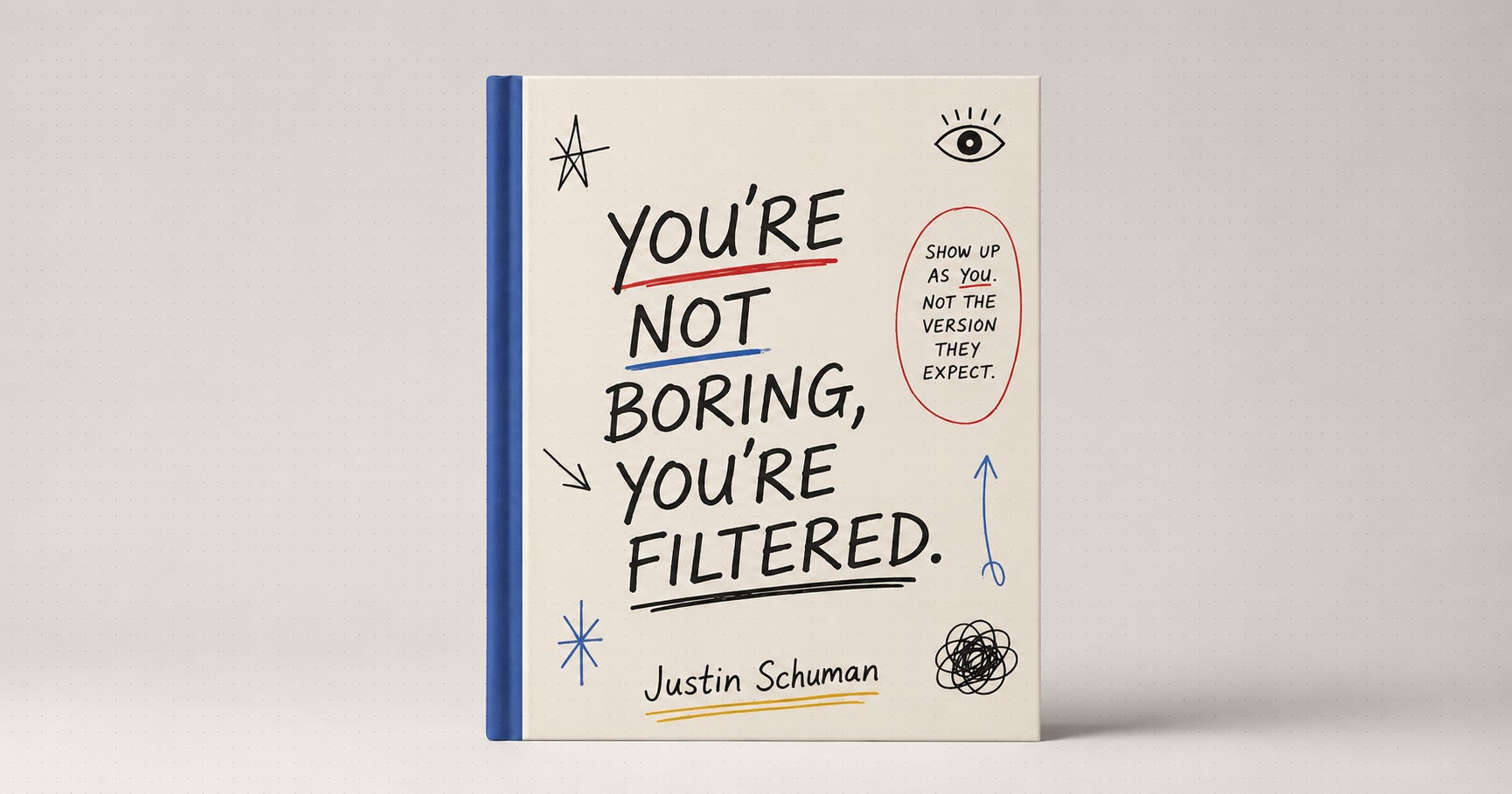
That’s the premise of this entire book: You are not boring. You are filtered.
Jackie wasn’t boring either!! she was filtered!!
She built a faceless business because somewhere along the way, she’d decided she wasn’t interesting enough. And the good luck of going viral served as CONFIRMATION that she’d made the correct choice. The money made the hiding look like strategy.
How she found her way back [the deprogramming, the freedom to make videos that felt cringe, what she’d tell you now] you’ll find at the end of this book..
But you first need to understand why self-editing happens at all.
Let’s start there.
Why We Edit Ourselves Into
Boring, Bland Chicken Breasts
The more remarkable your life, the harder it is to talk about.
… I don’t mean that as a compliment, you sweet gifted angel. I mean it as a diagnosis.
Look at Jackie: She built a business that consistently makes more than $100,000 in a single month and that’s changed her life. But she rarely talks about it.
I’ve invited her to share her story in different ways, at different times (content meant to build her personal brand… as opposed to the videos she makes for TikTok Shop). But she finds it genuinely difficult to do.
It’s this AMAZING thing that I know she’s proud of (when I make her sit with the feeling, lolol, helloooo somatic work).
But, for people who have edited themselves to belong. sharing the big things gets juxtaposed against the small self-image we carry, and saying them publicly feels aggressive, performative, and fraudulent.
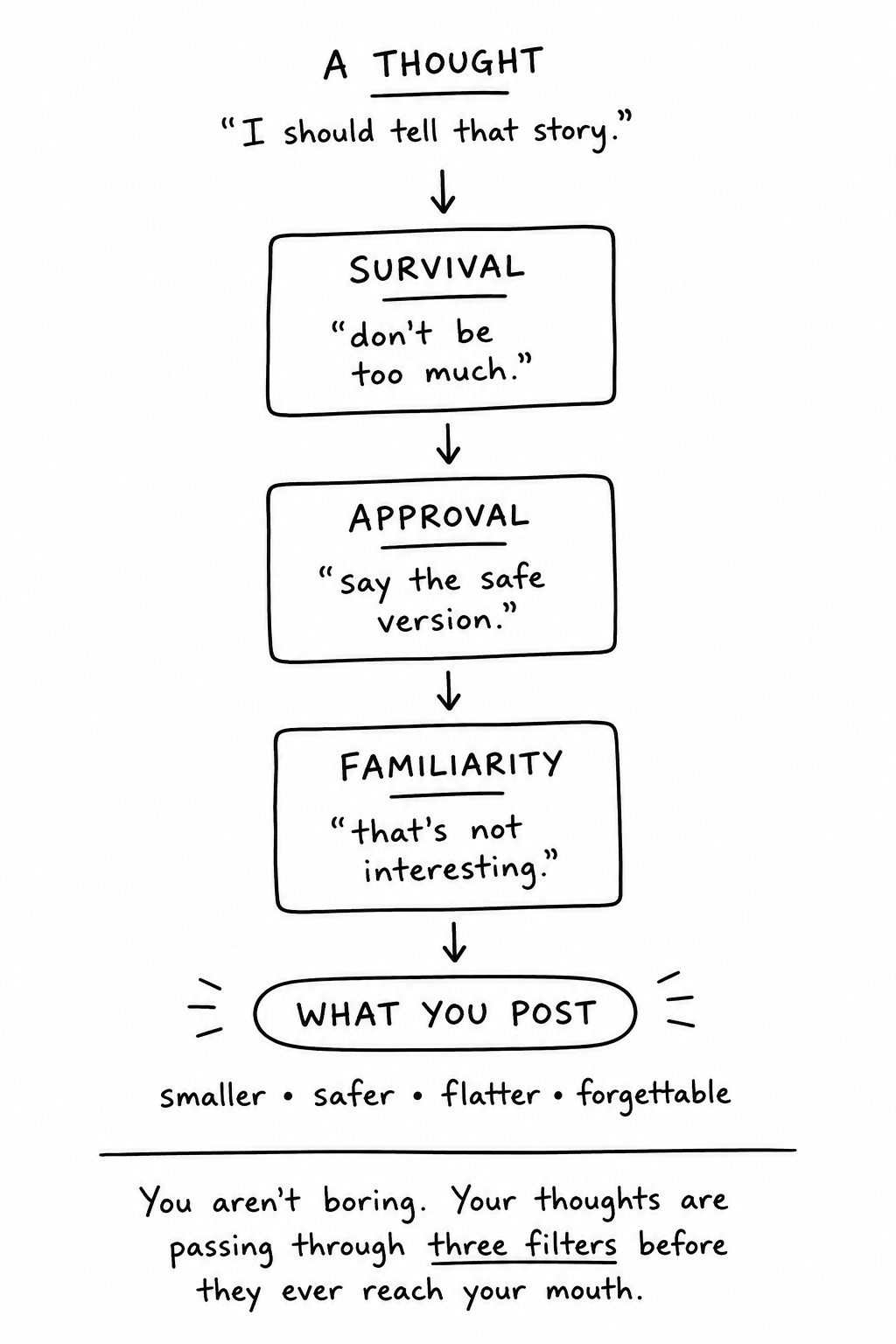
Almost everyone struggles with this for the same three reasons.
Think of them as three filters.
Filter #1: The survival filter.
We live in a culture where the loudest people are perceived as the most correct.
(This is especially true in the United States.)
The biggest personality in the room sets the temperature. And yet, a lot of us were raised with a version of the opposite message: don’t be too much!!! Don’t raise your voice. Don’t attract attention to yourself. Don’t brag about your accomplishments.
Parents don’t want to raise an asshole kid.
But more than that, they don’t want to be reflected in one.
So they teach you to fold in and be tolerable.
You don’t just “grow out” of that conditioning. Your body can experience standing out as a social threat, even when the actual danger is only disapproval. For most of human history, being cast out of the group meant you didn’t survive the night. So it’s not a quirk when your body initiates *MAKE SELF INVISIBLE PROTOCOL* and struggles to say the remarkable thing out loud.
That’s an active survival mechanism (even though the main threat today is some troll in the comments and not a sabertooth tiger rawr.)
So when we see people being big on social media, something in our bodies says “Ruh roh! Be careful!!! That’s dangerous.” coupled with “Well, they can do it because they’re special. I’m not.”
Filter #2: The approval filter.
A lot of people who are willing to talk on camera reach for the “approved” thought. (Even some of the ones you love watching. Just because they make it look easy doesn’t mean they’re their most fully expressed self.)
The approved thought is the one you’ve road-tested. You’ve turned it over in your head a thousand times, thought of every counterargument, and other people have signed off on it, so you feel safe sharing it.
The reason it comes out clean is because you’ve removed everything alive from it.
That thought is no longer interesting.
But you, as a person, are fascinating.
You’re just not letting yourself say anything worthwhile, because you filter for what feels safe. Professional. Polished. Palatable.
The thing that’s hardest for you to articulate, because it’s the least clear in your head, is the most impactful thing you could possibly say. I often think of it as an idea hiding behind a huge rubber band ball in your head that you first need to untangle before you can see it clearly.
That fuzziness is the part of you that hasn’t been edited yet. That’s why it’s so much more effective than the polished version. Like the most gorgeous cut of steak, before all the fat has been trimmed off.
The blurriest thought has the most flavor.
And the most impactful version of you rarely (if ever) shows up on camera.
 Tiktok failed to load.
Enable 3rd party cookies or use another browser
Filter #3: The familiarity filter.
We’re so afraid to be braggy, we stay too humble.
When something feels braggy to you, it isn’t necessarily because you’re saying too much. It’s because you’re too close to your own life to see it clearly, to even be objective.
You’ve lived your story every day.
You’ve told the story a hundred times.
You’ve forgotten which parts are surprising because they no longer surprise you.
The Russian literary theorist Viktor Shklovsky called this defamiliarization: the idea that we stop truly seeing things once they become familiar. The job of art is to make the familiar strange again, so we can experience it with fresh eyes.
Actors are literally trained to do this… to find the freshness and surprise in something they know like the back of their hand.
Which is why I think acting training is secretly one of the greatest studies of human behavior ever created. The job isn’t pretending. It’s learning how to experience something truthfully, over and over again, until an audience forgets they’re watching a performance.
Great actors aren’t masters of acting. They’re masters of being human.
When I performed Tina on Broadway, I said the same lines and watched the same moments unfold hundreds of times. Eventually, none of it felt surprising anymore.
But every night, there were people in the audience seeing the show for the very first time. They laughed where I no longer expected laughter. They cried at moments I had pretty much stopped noticing. If I performed according to how familiar the show felt to me, I’d rob them of discovering it for themselves.
The work wasn’t to invent something new every night. It was to remember that my familiarity was not the audience’s.
Your life works the same way.
Right now, you are the least qualified person to determine what’s remarkable about your own life.
You’ve lived it for years, so of course it feels ordinary! But your audience hasn’t.
They’re encountering your stories for the first time. The thing you almost don’t mention because it feels obvious may be the exact thing that makes someone trust you, remember you, or finally feel understood.
This is where it gets a lil’ psychologically weird. You can know something is objectively impressive while simultaneously feeling like mentioning it would make you sound full of yourself. Your brain holds two incompatible beliefs at once: other people would probably find this interesting and if I say it out loud, I’ll sound arrogant. Guess which feeling wins? Usually, you don’t say it at all.
Sometimes what feels like bragging from the inside is simply interesting from the outside.
The goal isn’t to convince yourself your life is extraordinary. It’s to recognize that you’re fundamentally incapable of experiencing your own life the way a stranger does.
So… stop trusting your own ears. 🙂
Right now, you’re the overly-familiar, overly-invested audience of your own story… soooo deep your feelings gurl (the vulnerability of saying something personal out loud, the fear of how it lands, the voice that says don’t be too much) that you can’t hear what you’re saying. You just feel the danger of saying it.
[I say all this as a deeply sensitive and HIGHLY FEELING baby boy myself.]
Step into the observer’s seat instead. Hear yourself the way a stranger does. Because I promise you: the thing that feels braggy to you just sounds specific to the person hearing it for the first time. It sounds real. Like a reason to lean in and keep listening.
You don’t have to be an egotistical fuck. hehehe
Instead, you can be self-assured, self-evident, sovereign, and specific.
I know that might seem scary. Being specific means your angularity being seeable, and being seeable means people can have opinions about you.
You’re putting yourself in the line of fire of other people’s perceptions. But you can do it without being in life-threatening danger.
For example, I gave a TEDx talk in 2022. When I need to share that information, I don’t apologize for it or oversell it. But I also don’t downplay it — “I mean, I did give a TEDx talk, I guess, if that matters, but it wasn’t a big deal…” That’s a flattened version. Instead, I say it with the impact it deserves:
“In 2022, I gave a TEDx talk on the practice of being yourself.”
Because you know what?? It IS kind of a big deal. But I can KNOW that and say it while knowing it without making sure I know you ALSO KNOW it after I’ve said it. Nah mean?
Most people flatten their achievements because the childhood messaging and the survival instinct run deep: don’t gloat, don’t make anyone feel less than, don’t act like you’re special. By following all those rules, we blandify ourselves. And to me, blandifying is deeply more offensive than being polarizing.
It’s more honest and human to have a strong opinion than no opinion.
Psychologists have a name for one piece of this — the curse of knowledge: once you’ve lived something deeply enough, you lose the ability to feel its weight.
The extraordinary becomes ordinary. Remarkable becomes routine.
I see it constantly, with clients and just scrolling my feed. Someone will be two-thirds of the way through a video and say something like,
“Last year I was laid off and had to move back in with my parents.”
I started my own business, got a bunch of clients, and now I film 15 videos before noon.”
They say it like a passing thought. Like the rest of us are supposed to hear that and just be like… “ok.” And move on.
I want to grab their beautiful shoulders, shaaaaake them, and say:
DO YOU HEAR WHAT YOU JUST SAID?
The answer is often no. They don’t.
When you say you were the first person in your family to go to college, you need to hear that differently.
When you say you rebuilt your life after going completely bankrupt, you need to feel the weight of that sentence as it leaves your mouth.
When you say you left the religion that raised you and had to figure out who you were without it, you need to know that’s not background noise.
Strangers listening to your story resonate with these moments, but not if you brush them off.
And it isn’t only familiarity. Remarkable things about your own life are also vulnerable. If you deliver them flatly, like they’re nothing, you stay safe. Nobody can accuse you of bragging. Nobody can say you think too highly of yourself.
Unremarkable delivery is a protective mechanism.
You just keep saying the remarkable thing like it’s nothing, and eventually… nothing is what it becomes.
These three filters have one result:
the most interesting parts of you never make it out of your mouth.
Now, let’s talk about what those filters do to you the moment you sit down to record.
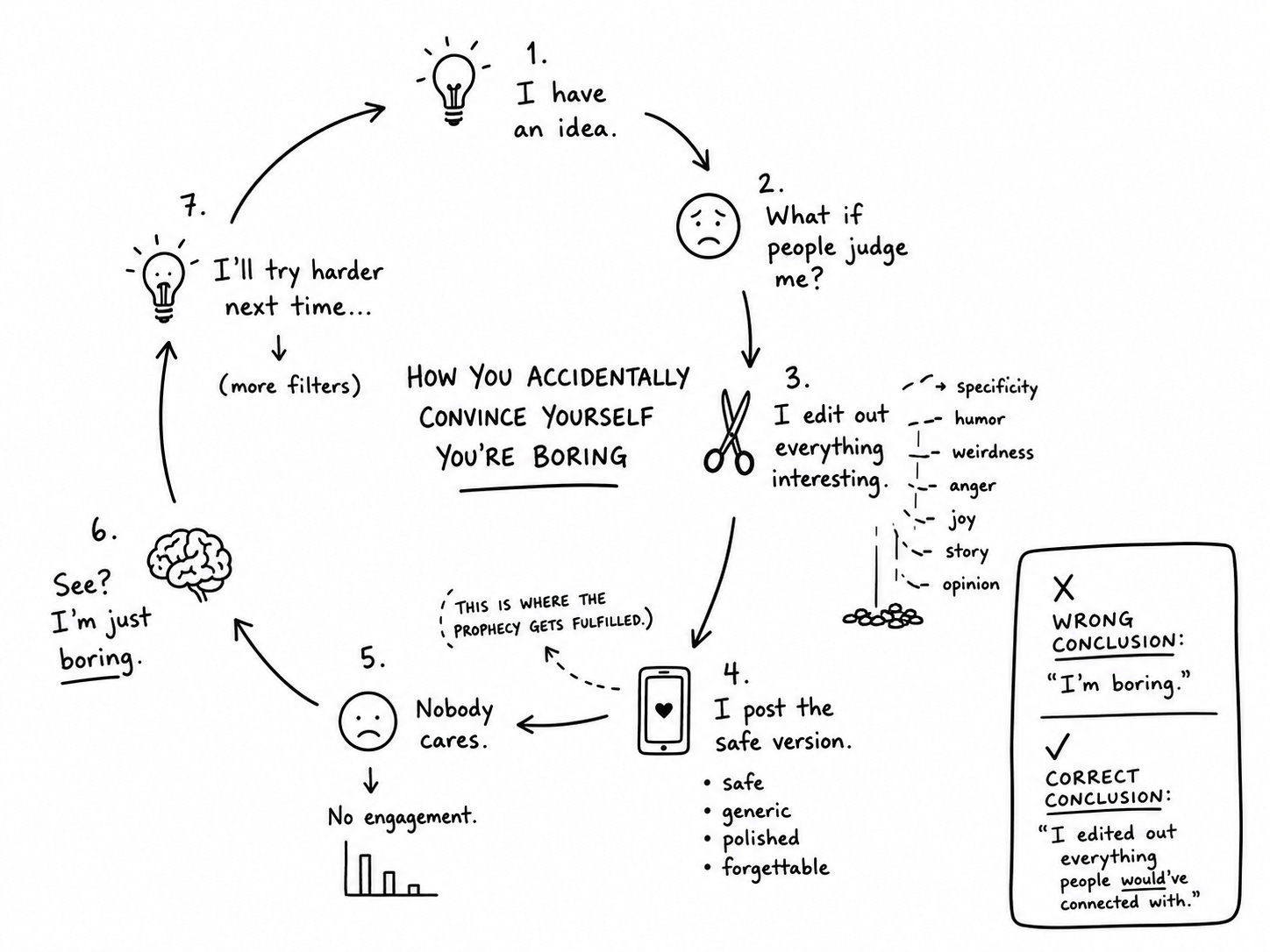
The Self-Editing Loop
You get ready to make a video because you have a thought. (Or maybe the thought is simply, “ugh I should really post a video.” which isn’t ideally the impetus for your posting but we can cover that in another mini-book.)
But before an honest thought reaches your mouth, the filters kick in.
Will this make me look bad? Is this even useful? Will people think I’m bragging? What if this offends someone? What if my parents see this? Am I about to overshare? Is this what my audience wants? How do I say this fast enough that they don’t scroll past?
If your filters are strong, and your ego screams DANGER loud enough, you’ll close the camera before even hitting record.
Or maybe you’ll hit record, stop, hit record again, stop again.
Re-record. Do another take.
With every attempt, you chase a version of yourself that feels correct enough to keep.
Maybe you record something great and let it die in your drafts.
Maybe you finally edit the video, but editing sucks all the life out of it (and you), so you never post.
But let’s say you do post a video.
You smooth the edges. Strip out anything vulnerable, specific, or strange.
You hit publish.
MORE OFTEN THAN NOT… nothing really happens. Very few views. One comment? Maybe none? Which you read as proof that confirms the thing you were afraid of:
I’m just not interesting enough.
So you go back and do the whole thing again, a little more carefully this time.
A little more edited. A little more safe.
That’s the Self-Editing Loop.
It’s hard to escape because every filter feels rational.
Thoughts don’t go from your gut to your mouth.
They go: gut → brain → several filters → pit stop for lunch → then out.
How many filters does a thought pass through before it finally blerppphhhh spews out? If you’re like most people, you’ve never counted. You know something feels off, and your videos aren’t working. But every filter feels like good judgment. So you put on the mask and edit out the parts that would make someone stop scrolling.
Now, we all wear masks at one point or another. Masking isn’t a flaw or a pathology. It’s adaptive.
You learned early which version of yourself was safe to bring into a room and which parts to leave outside the door. You calibrated yourself for the comfort of everyone around you, until you forgot you were doing it.
This is why so many people who come to me don’t simply struggle to talk on camera.
They struggle to know who they are underneath the edited versions.
I’m here to say: you’re not too little, and you’re not too much. You’re not less than, and you’re not more than you should be. You just don’t know what you are, because you’ve spent so long adjusting for everyone else that your own baseline got lost somewhere in the process.
Here’s why this isn’t just a content problem.
Judith Butler is a philosopher whose work on performativity (specifically surrounding gender) offers a useful way to understand what’s happening here: identity is not merely something hidden inside us, waiting to be revealed. It is also built through repeated acts.
In simpler terms… what you repeatedly perform begins to feel like who you are.
Sit with that for a second.
If you perform the careful, edited, blandified version of yourself for long enough, it stops being a costume and starts being you. Your performance becomes your personality.
The mask becomes the face.
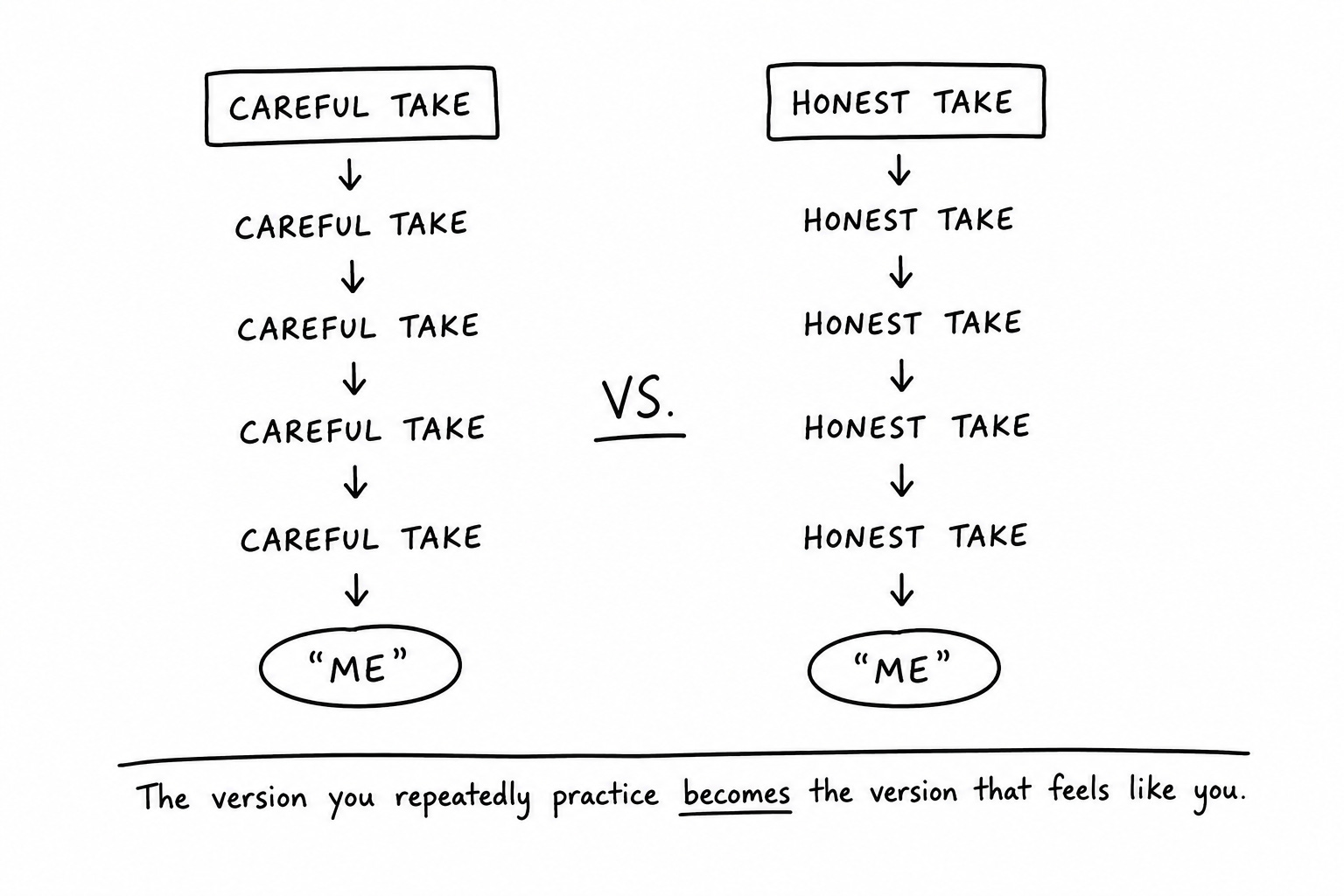
The loop isn’t just costing you views. It’s manufacturing your identity, one careful take at a time.
Scripting won’t help you escape the Self-Editing Loop.
A lot of people try to solve their filter problem with scripting. Scripting is the most pervasive “skill” I see, and it doesn’t work the way people think.
The belief is: if I write it out first, I’ll get clarity. Then I can use the script to say what I mean. The logic feels airtight, but it’s riddled with holes.
Scripting only gives you access to what you already have access to. It doesn’t invite your intuition to the table. It doesn’t allow your impulses, your emotions, or your sensibilities to surface, because you decide what to say before any of that gets a chance to show up.
You’re not finding your voice. You’re polishing and refining a performance. The version of you in the script becomes, per Butler, who you are. You’re editing “you” before you have a chance to come out. (Which is why you’re so obsessed with doing it ;) because it feels realllll safe.)
The practical problem is that reading from a script naturally is a different skill. (It’s what actors train for years to do well.) And if your central problem is that you edit yourself before you speak, scripting turns that edit into a finished product before your instincts ever enter the room.
You think you’re getting more clear. You’re actually getting more filtered.
The answer is fewer filters.
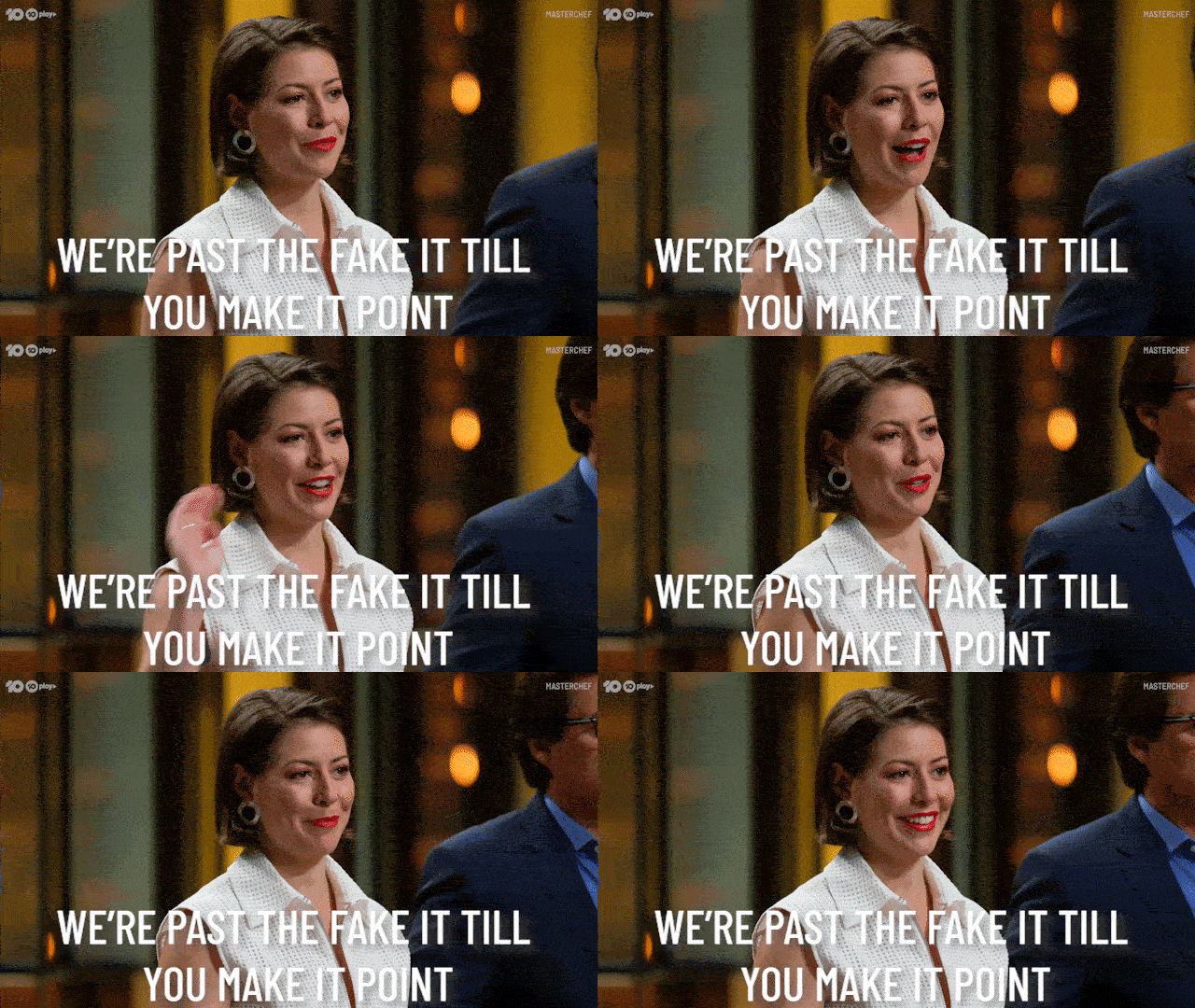
When the Filters Fall Away, You See Yourself
You can feel this happen.
(Not metaphorically. You actually, physically feel it.)
Editing yourself is both a thought process and a body experience.
Feelings don’t live in the head — they live somewhere below the neck, and they show up as tightening, tummy heaviness, or a gripping pulling you toward the safer version.
So when you sit down to record and start cycling through six different versions of you, trying to find the one that feels safe enough, that’s not a creative decision. That’s fear running through your nervous system. That’s your editing system, live and in action.
Start noticing how your filters feel… not to judge them, but to acknowledge their existence.
(You can’t change what you can’t observe.)
Here’s what this looked like for someone in ShowUp90’s office hours:
She came in believing she was showing up as herself on Instagram. She’d done the work. She was thoughtful, self-aware, and emotionally intelligent.
During office hours, I review content that students submit, and after we watched her reel as a group, I reflected back to her a disconnect between the person in front of me right now (her in the Zoom), who felt real and present and specific, and the person in her reels, who had this airy, slightly breathy, softer voice. It was a little higher than her natural register, and it was carefully pleasant.
She sat with that for a second.
Then she said:
“I do think I’m a people pleaser. I put on this tolerable version of myself.”
She hadn’t known she was changing in front of the camera. She genuinely thought the “carefully pleasant” version was her. She wasn’t performing consciously. She had performed that version for so long that it had become her default. Her realness wasn’t real on camera.
That moment of recognition — oh my god, my realness isn’t real — is always the beginning.
This is what I mean when I say the filters go invisible. Everyone tells you to “take off the mask,” advice that assumes you know you’re wearing one. That you can feel it. That you know where its edges end, and the rest of you begins.
You don’t.
If you knew you were performing, you’d have stopped by now.
The fix isn’t just more self-awareness. It’s learning to notice when you’re editing, and making the choice to be different so you take back authorship over who you’re being.
Over the last five years, I’ve watched hundreds of people unedit themselves — in coaching sessions, in ShowUp90, and in the years I spent doing headshot photography. There’s a specific moment when the person’s face changes… as if the mask were real and it had just fallen away and something underneath it arrives. I think the same thing every time: there you are. The face beneath the face.
You might have felt a version of this — the first time someone you love got genuinely vulnerable with you and their face looked different, like you were seeing them for the first time. That’s what it looks like when the filters fall away. In someone else, you can see it immediately. In yourself, you almost never can.
Unediting yourself doesn’t look like a big announcement or a dramatic transformation.
Some people arrive by getting quieter. Some by getting louder. Some by finally letting themselves curse, or sit differently, or stop wearing the blazer they hate.
The hiders go from small to colorful.
The performers finally stop being “on” and relax into a more honest version of themselves.
The ones who feel like they’re over-the-top are finally being natural. The ones who feel like they’re “not doing anything” are finally being themselves.
This matters beyond social media, because the way you post is the way you do everything.
Social isn’t a separate dimension you step into and out of… it’s a mirror for life.
The way you show up on camera is a reflection of how you show up in relationships, rooms, and conversations where something is at stake. But the camera does something almost nothing else can: it lets you experience yourself from the outside. Most of us move through life only ever knowing what it feels like to be ourselves. We almost never witness how we’re actually coming across. Then you hit record, watch the playback, and meet a version of yourself you didn’t know you were projecting.
For a lot of people, that first reaction isn’t: “That’s me.”
It’s: “Wait... that’s how I come across?”
You’re not seeing your authentic self. You’re seeing the version of yourself that learned how to be perceived. The customer-service voice. The over-smiling. The over-explaining. The apologizing. The performing. The camera didn’t invent those behaviors. It simply made them visible.
That’s where the work begins. Once you can see the performance, you get to decide whether it’s actually yours. Maybe it is. Maybe it isn’t. But for the first time, you have authorship instead of autopilot.
And unlike a conversation that happens accidentally, a video is a choice. You can’t accidentally create a content piece.
Posting a video is you deliberately choosing to be visible.
It’s an aggressive act of self-expression, in the best possible way, and it magnifies everything.
Every edit you make in that process is a decision about who gets to be seen.
@justinschumanofficial on instagram
That’s why Butler’s theory is so important. If you start performing a truer version of yourself — even before it feels natural — you will begin to become it. The performance IS the practice.
The decision isn’t whether you’re ready to show up as yourself.
It’s whether you’re willing to start practicing.
Why Private Work Isn’t Enough
To Make Public Change
The people I tend to attract and then work with or simply interact with on social media have usually done a lot of self-healing work. Like, genuinely done it.
They go to therapy, practice journaling and mindfulness. They’re emotionally intelligent. They have a soft, gooey center. They know that yapping over a bed of nonsense is just hot air — which is exactly why they haven’t been able to make themselves do it.
But they still don’t show up online the way they want to.
I want to be really honest about why, because it’s the thing people least want to hear after they’ve already done so much.
Insight and capacity are different things. You can understand exactly why you hide… trace it to its roots, name it as if you yourself had gotten a masters in Psychology… and still have zero capacity to stop hiding when someone is watching.
Self-awareness tells you why you’re hiding.
Self-capacity determines whether you can stop hiding when it matters.
Here’s the reason. People-pleasing, hiding, and performing the edited version of yourself are a full nervous system response. The nervous system doesn’t get triggered by your journal or in your therapist’s office. It gets triggered by other people watching you.
You’ve heard of exposure therapy? Well… this is basically that.
The mechanism = repeated contact with the experience of being seen can teach your system that visibility is survivable.
You don’t practice the response in a safe room and then hope it transfers when the real thing shows up. You have to be “triggered” for the practice to count.
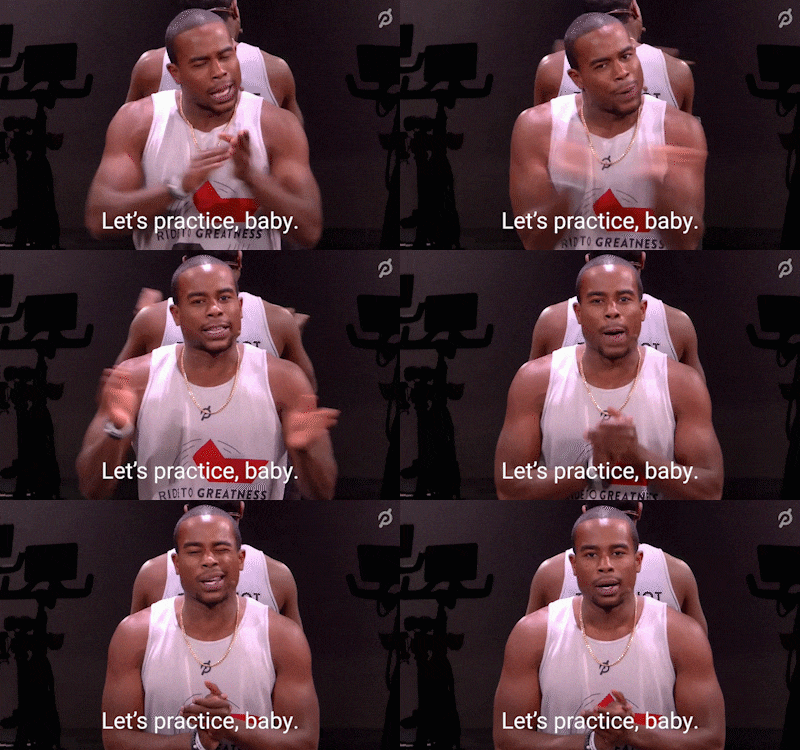
There are two kinds of work here, and you need both.
Internal work: Therapy, meditation, journaling, self-worth, self-trust. Keep doing all of this, and don’t stop. It prepares you beautifully for what comes next. It just can’t do the next part for you. Chances are this is the work you’ve done the most of.
External work: Self-expression, self-actualization, and being different in the world while people are watching. This is the part you can’t skip. If you want to stop going small when people are watching, you have to practice being seen in public, doing the thing that scares you.
Private work prepares you.
Public practice integrates you.
I know how this sounds if you’ve already done years of private, courageous inner work.
Yes, all of it counts. You can catch me doing the work on a couch in somatic therapy every Thursday! I get it! The private work is the necessary first half of something that requires a second half — and the second half can’t happen out of sight.
Think about a gymnast training for the Olympics. Every private rep is essential but ultimately not sufficient. Simone Biles can’t do a floor routine in front of an audience for the first time at the Olympics.
Your nervous system has to have been there before: in public, with stakes, with the possibility that someone watching might not love what they see.
The risk makes it work.
@justinschumanofficial on instagram
Look. This is fucking hard. (I want to say that plainly, because I don’t think anyone says it plainly enough.)
The messages I get from people in the middle of ShowUp90 are always some version of: this is so much harder than I thought it would be.
And I’m like: yeah, of course it is!!
You’ve never forged yourself in fire this way before. Why would you have?
But they come out the other side changed, because they did the public, witnessed, uncomfortable thing every single day — until, at some point, it stopped being hard in the same way.
So if you’ve been sitting in the private half of this work…
*rubs hands together as if we’re about to do some real shit*
It’s time to break out the camera.
How to Show Up as Yourself,
On and Off Camera
Everything you’ve read so far has been explanation.
Everything from here forward is practice.
If you’ve been editing yourself for a long time,
your personality muscle has atrophied.
And when you start using it again, it’s going to feel strange and clownish. Over the top. Waaaaay too much. That’s a NORMAL sign you’re doing it for the first time, or after a very long break.
Think of a thirty-pound bicep curl after years of nothing.
The discomfort isn’t failure. It’s the feeling of remembering you exist. 🥲
There’s a physical-therapy nature to this work. It’s repetitive and somatic — a body shift, done over time, in public, with witnesses. Which means you can’t think your way through it.
You have to do your way through it.
Here’s how to begin.
#1. Be honest with yourself.
Before I start working with a new client, I ask them two questions. If the answer to either is “no,” the rest of this won’t work, and I’d rather us BOTH know that now.
Am I willing to compartmentalize everything I’ve been told about social media?
Most of what lives on the internet right now is filtered, obnoxious noise — AI-generated carousels, faceless accounts, and talking heads regurgitating strategy, plagiarizing each other, or relying on aesthetics and a fancy mic.
The result is a ton of content that is perhaps technically correct, polished, and on-brand… but completely forgettable.
Talking like a human is the hardest and least-rewarded thing to do on the internet right now. Which is why it’s the most powerful.
*shouts into megaphone* Step away from the hook frameworks and posting schedules down for now. You can pick them back up later if you want.
That thinking can’t be in the room while we’re doing this work.
Am I willing to accept that who I think I am might not be exactly who I actually am?
This is the big one.
The person you believe yourself to be… the one you’ve been trying to build an online presence around… has been curated by years of editing, adjusting, folding in, making yourself tolerable.
What’s much more true for you has been hiding underneath that for a long time (maybe decades). The gap between who you’re performing and who you are might be four inches, or it might be worlds. From the outside, closing it can look small. From the inside, it can feel like demolishing the whole house.
That possibility is destabilizing, I fully acknowledge that, and I’m not going to ask you to be comfortable with it. I’m advocating for the destabilization.
There’s so much discourse around self-healing and “the discomfort of growth,” and most of it exists to reassure you that it won’t be that bad. I won’t do that. Tearing the house down to the studs and rebuilding yourself in your own image is some of the most powerful work a person can do — precisely because it isn’t gentle.
You don’t have to announce this to anyone or make a declaration. Just sit with the possibility that the version of yourself you’ve been performing — online, in your relationships, and in your life — might not be the whole picture.
If you can say yes to both questions, you’re ready for step two.
#2. Find your somatic “safe” and “unsafe” signals.
The impulse to self-edit comes from your head but the feeling of danger comes first from the body… so you want to learn to read your own body’s signals.
They’re already there, and you’ve probably been ignoring them for years. To tune in, think of two situations in your life: one where you feel completely unsafe, and one where you feel completely safe.
In the unsafe one: Where does your body seize up? Chest heavy? Jaw tighten? Shoulders raise? Stomach drop? That tightening is data. You don’t have to interpret it yet… just locate it.
In the safe one: What’s absent? Where do you breathe differently? Do your shoulders drop? Does something in your belly relax? What does it feel like to let your guard down?
Learn how these two states feel in your body. Because when you sit down to record and your body tightens, that’s information — a filter is probably about to go up. (The task is to observe, not to instantly decode.) And when you relax mid-video and stop thinking about what you’re saying, that’s your body signaling you’ve arrived.
You can’t edit yourself into presence.
But you can learn to feel the difference between when you’re in it and when you’re not.
#3. Follow the primordial ooze of honesty.
I’m a professionally trained actor, and acting is living truthfully under imaginary circumstances.
What does it mean to live truthfully?
For me, it means following the primordial ooze of honesty in your gut… a quiet steady stream of ancient wisdom that your body is already producing, constantly, whether you’re listening to it or not. It’s tuning into the truth before your brain gets involved and starts editing it into a more polished version.
Here’s an exercise you can do alone in your bedroom, walking around your kitchen, or wherever you are right now.
Ask yourself out loud: What am I feeling right now?
Not what you’re thinking. Not your to-do list or what you should post. What are you feeling, right now, in your body? Just sit there… and feel it. Let something vomit out of your mouth without editing or filtering it.
Curation comes from your brain. What I’m asking you to access comes from your body.
For me, right now: I’m feeling a little stale heaviness in my tummy. I feel like today has been like C+ productive. I’m appreciative that I showed up and did the work I wanted to get done? But a small nagging pang tells me there’s more to do. This isn’t profound, but it’s true.
The idea is to listen to what your body is telling you, especially when nobody’s watching. This is one of the first things you need to do to excavate and rediscover your personality. You might not think you matter enough to do this. You might not think you’re interesting enough. You might not think you deserve to take up this kind of space.
Take up the space, baby.
#4. Give yourself a runway.
Get out your camera, but don’t pre-plan what to say. Don’t think about hooks or length or whether this would perform well. Don’t think about posting. Just hit record and notice what happens.
Does something shift the moment the button is pressed?
Does your voice change? Does your face do something different? What’s it like to see yourself be yourself?
Can you sit with yourself on camera, or does something in you want to stop?
Record a thought once, all the way through. Don’t stop recording if you mess up. Just take a breath and keep going. You can edit after… right now, the point is the single take.
A lot of my ShowUp90 students assume that the second they hit record, whatever comes out first has to be the opening of the video. It doesn’t!!
Consider this, planes need a runway to take off — you, too, have to build momentum before you get in the air. So when filming, give yourself a runway. You don’t even have to stop the camera. Just start talking, find your footing, and see it through to the end. You can trim the hemming-and-hawing runway when you’re done recording.
Find out what lives in the one take, without cutting it short.
#5. Post your most honest self for 7 days.
This is where you start being seen. I know what you’re thinking, because I’ve watched hundreds of people think it before you:
“Seven days sounds manageable. Fine. But what does “honest self” mean when I’m staring at a camera?”
It means you don’t script it.
You don’t do seventeen takes.
You follow the flow of your delicious non-linear thoughts, let it land somewhere, and then you post it.
Somewhere in the first week, perhaps something will crack open.
Filming will still be hard but you do it anyway.
Maybe it’ll actually feel ok one day!! Which is like executing the perfect crumpled paper ball trash can toss when nobody’s watching. Did anyone see that?! Even if no one did, you’ll know you made it. Around a month, the thought changes: “I can’t believe I’ve done this every day.” And if you keep going, one day you’ll rewatch your Day 1 video with shock, awe, and appreciation because you’ve moved that far from the person in it.
That’s the work working.
And if you take it all the way… 90 days of doing the hard, public, witnessed, uncomfortable thing… you come out the other side changed. You forge yourself in fire, voluntarily, for three months, which almost no one on earth does. That’s exactly why it works.
One of my favorite examples is Kiko, who became more grounded and sure of herself throughout the program. Just look at the difference in her voice and energy on Day 1 versus Day 90.
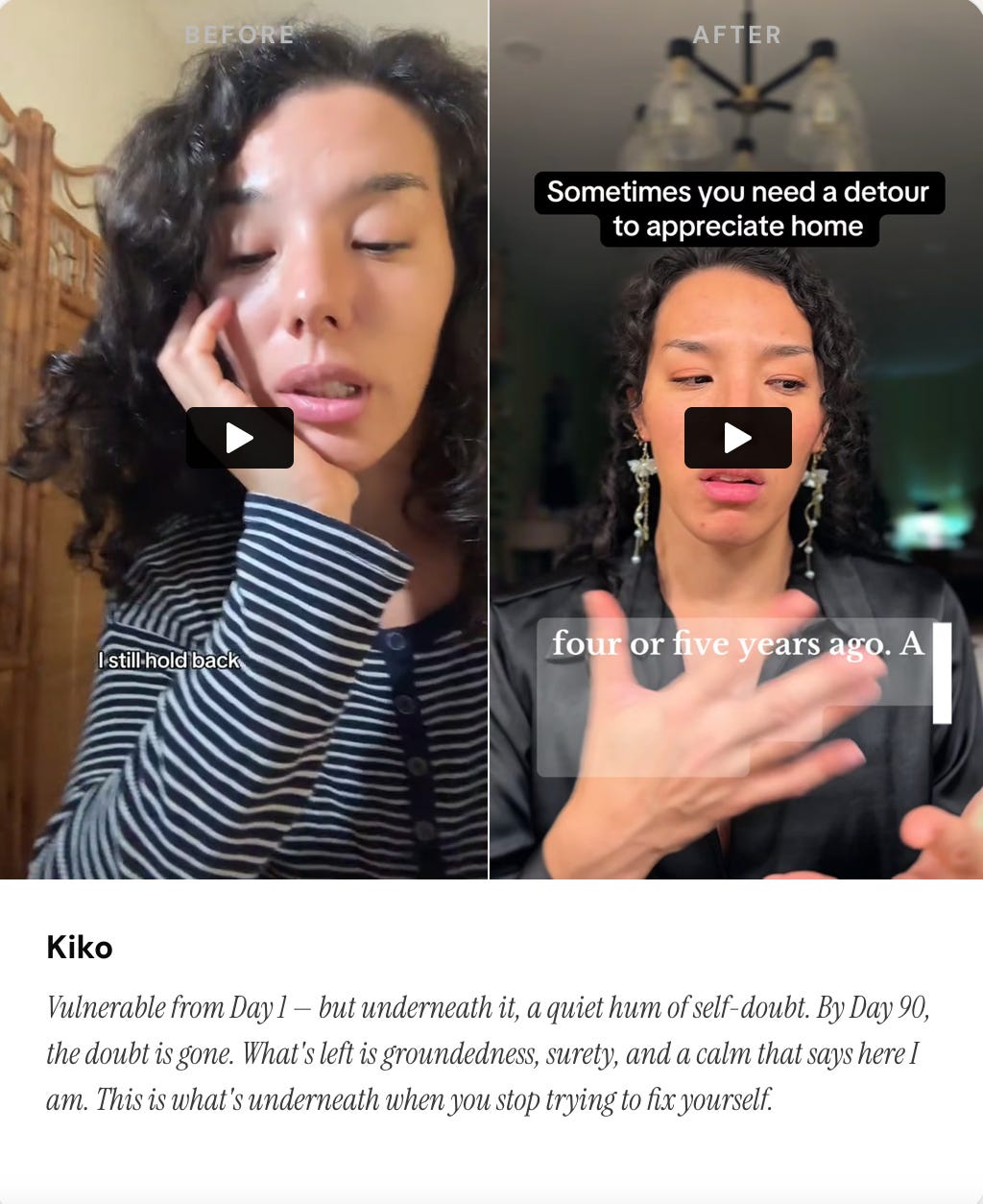
Vulnerable from Day 1 — but underneath it, a quiet hum of self-doubt. By Day 90, the doubt? Gone. What’s left is groundedness, surety, and a calm that says, Here I am. This is what’s underneath when you stop trying to fix yourself.
#6. Return without explanation.
You’re going to fall off. I’m just telling you now that you will! That is not failure. But most people treat it that way. You miss a day, then a few, and then the re-entry feels like it needs to be a whole thing. So you post a long explanation, a comeback arc about why you’ve been gone. Becuase you think the people will have noticed? That they’ll care?
That’s still editing. You’re making the absence a performance.
Don’t do that. Just show back up, without a production or an apology.
The re-entry is the rep.
Who Are You
When The Camera Is Rolling?
When you share videos of yourself, you find out who you are under pressure. You can’t replicate that pressure by thinking about it more. You can’t get there by reading more books, doing more journaling, or having one more therapy session where you talk about the thing instead of doing it.
At some point, you have to get on the balance beam and start posting.
The camera doesn’t lie — it’s a receipt of what was.
Whatever you bring to it, that’s what it gives back. It’ll capture the edited version, but it can also reveal who you are when you stop performing. Every time you hit record, you’re documenting who you are right now. You’re saying: I was here. I had something to say, and I said it.
Maybe you’ve been playing the tolerable, palatable version of yourself for so long that you’ve genuinely lost track of who’s underneath it. That’s what happens when you run the same performance for long enough. Per Butler, you become it. So the question isn’t whether you’ve been doing that. (You have. We all have.)
I can tell you what’s on the other side, because I’ve lived it. After five years of making videos, showing up, and letting myself be witnessed, I’m more healed than ever.
I kept practicing being seen until being seen stopped feeling like a threat. Social media changed me. Visibility changed me — and the lessons didn’t arrive gently. But now I like myself so much more. I don’t care what others think nearly as much, because I’ve built up my sense of self and my self-worth. I DEFINE me. No one else does. That’s the agency and sovereignty to author your own life.
And Jackie? My TikTok Shop seller client from the beginning of this mini-book?
Jackie didn’t need another viral strategy. She needed evidence that she could survive being seen. She spent real time deprogramming — plenty of the early face-forward videos felt cringe to her — and then those videos started going viral, and her TikTok Shop and her revenue grew beyond what she thought possible. But that’s not the part I care about most.
The face-forward videos didn’t just grow her business. They gave her back to herself.
Here’s what she said, looking back on the work:
“When I started, it was faceless videos and panicking when those videos die — which they have. I would have been so screwed. I wouldn’t feel this peace that I have now. Having these wins, these viral videos with me in them — this is just the beginning. We’re just getting started.”
The same is available to you.
The strange, counterintuitive thing I’ve watched play out across hundreds of people is that when you stop looking outside yourself for evidence that you matter, you become more yourself — and your audience feels it. You vote for that version of yourself every time you hit record and say something true. You say: I deserve to take up at least this much space.
So I want to leave you with this.
Who are you when the camera is rolling — and is that who you want to keep becoming?
Because you get to decide that, starting now.
– Justin Schuman
P.S. - Ready to practice?
You know being seen would change your life.
But you also know you’ll avoid it without someone making you show up.
That’s why I created ShowUp90 — a 90-day posting practice helping people who learned to edit themselves for belonging become self-authored through the practice of being seen.
It’s always open, and you can start as soon as tomorrow.
As a blog titles How to Human, on a post about being your unfiltered authentic self, addressing the audience “hello fellow human” I’m really disappointed to be getting an AI voiceover.